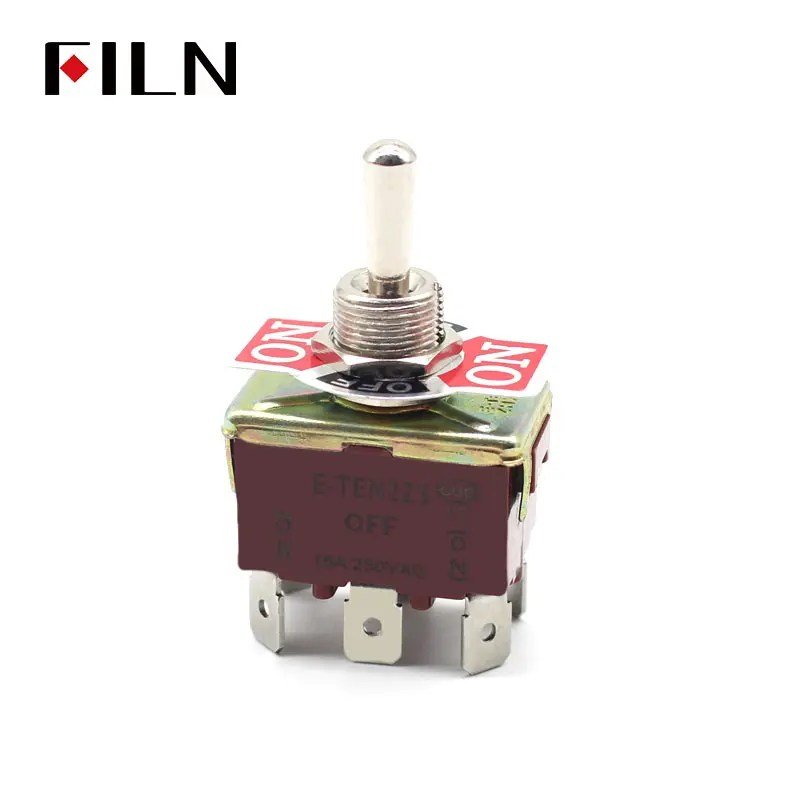
Ever wondered how a single flick of a switch can simultaneously manage multiple circuits, perhaps reversing a motor or seamlessly swapping between audio sources? It’s not magic; it’s the quiet efficiency of a DPDT relay. In the world of electrical control, Understanding DPDT Relays: Definition & Functionality is a cornerstone for anyone looking to bridge the gap between low-power control signals and high-power applications. These versatile components are the workhorses behind countless automated systems, offering a robust and reliable way to manage complex electrical switching with elegant simplicity.
As a seasoned observer of all things circuits and control, I'm here to demystify the DPDT relay, breaking down its inner workings, illuminating its indispensable benefits, and guiding you through its practical applications. Prepare to gain a crystal-clear understanding that will empower you to integrate these powerful little devices into your next project with confidence.
At a Glance: Your DPDT Relay Cheat Sheet
- What it is: A DPDT (Double Pole, Double Throw) relay is an electrically operated switch that controls two separate electrical circuits at the same time using a single low-power signal.
- "Double Pole": Think of it as two completely independent switches, operating in unison.
- "Double Throw": Each of those two switches can connect to one of two different output paths.
- How it Works: An electromagnet, activated by a small current, physically moves internal contacts, flipping both sets of poles from one position to another.
- Key Benefits: Allows low-power control of high-power devices, provides crucial electrical isolation, and enhances safety.
- Common Applications: Reversing DC motors, switching stereo audio signals, and managing power between different sources or loads.
- Important Note: Always verify pinouts with a multimeter before wiring, as configurations can vary by manufacturer.
What Exactly is a DPDT Relay? Unpacking the 'Double Pole, Double Throw'
At its heart, a DPDT relay is an electrically activated switch, a component that uses a small electrical current to control a much larger one. But the "DPDT" part is where its unique power lies. Let's break down this acronym:
- Double Pole (DP): This simply means the relay has two separate, independent switches or "poles." Imagine two light switches that you operate with one hand, simultaneously. Each pole can control a completely different circuit, or they can work together to control aspects of a single, more complex circuit.
- Double Throw (DT): For each of those two poles, there are two possible "throws" or connections it can make. This means each switch can connect to one of two different output terminals. When the relay is unpowered, the contacts are in one position (often called Normally Closed or N/C). When power is applied, they "throw" to the other position (Normally Open or N/O).
So, in essence, a DPDT relay gives you the ability to control two distinct circuits, and for each circuit, you can choose between two different paths or states. This versatility is a significant upgrade from a simpler SPDT (Single Pole, Double Throw) relay, which, as the name suggests, only offers one pole to switch a single circuit between two paths. Understanding the differences between SPDT and DPDT relays is key to selecting the right component for your specific needs.
The Inner Workings: How a DPDT Relay Switches Your Circuits
The magic of a DPDT relay, and indeed most electromechanical relays, lies in a fundamental principle of physics: electromagnetism. While it might sound complex, the operation is elegantly simple once you understand its core components:
- The Coil: This is the control input. When a small electrical current is applied to the coil, it generates a magnetic field. Think of it as a temporary magnet that you can switch on and off.
- The Armature: This is a movable metallic piece, often hinged or pivoted. It's attracted by the magnetic field generated by the coil.
- The Contacts: These are the actual switching elements – the points where the load circuits make and break connections. A DPDT relay typically has two sets of contacts, one for each "pole." Each set includes:
- Common (C): The input terminal for the circuit being controlled.
- Normally Closed (N/C): The terminal that the Common is connected to when the coil is de-energized (no power).
- Normally Open (N/O): The terminal that the Common connects to when the coil is energized (power applied).
The Switching Sequence: Energize, Switch, De-energize, Return
Here’s a step-by-step look at how it all comes together:
- Initial State (Coil De-energized): When no power is applied to the relay's coil, the armature is held in place by a spring. In this "default" state, the Common contacts for both poles are connected to their respective Normally Closed (N/C) terminals.
- Activation (Coil Energized): When you apply the specified control voltage (e.g., 5V, 12V, 24V) to the relay's coil pins, current flows through the coil. This creates a magnetic field.
- The "Throw": The magnetic field attracts the armature, pulling it towards the coil. This mechanical movement causes the armature to "throw" or switch the Common contacts for both poles from their N/C positions to their Normally Open (N/O) positions. Now, the power flows through the N/O terminals.
- Deactivation (Coil De-energized): When the control voltage is removed from the coil, the magnetic field collapses. The spring then pulls the armature back to its original position, returning both Common contacts to their Normally Closed (N/C) terminals.
This entire process happens incredibly quickly, often in milliseconds, making DPDT relays highly responsive. If you're looking for a clearer visual, it helps to review a Double pole throw relay schematic to see how these components are represented in circuit diagrams. Understanding the how electrical relays work provides an excellent foundation for grasping the DPDT's specific functionality.
Pinning Down the Connections
A typical DPDT relay has eight pins:
- Two Coil Pins: These are where you apply your low-power control signal to energize the coil.
- Six Contact Pins: These are arranged as two groups of three. Each group corresponds to one pole and contains:
- One Common (C) terminal
- One Normally Closed (N/C) terminal
- One Normally Open (N/O) terminal
Understanding these pins is crucial for correct wiring, which we'll cover in more detail shortly.
Why DPDT Relays Are Indispensable: Core Benefits You Can't Ignore
DPDT relays aren't just clever; they offer concrete advantages that make them essential in a vast array of electronic and electrical systems. Their core benefits revolve around efficiency, safety, and operational versatility.
1. Control High Power with Low Power
Imagine you need to switch a powerful 120V AC motor on and off, but your control signal comes from a delicate 5-volt microcontroller. Connecting the microcontroller directly to the motor would instantly destroy it. This is where the DPDT relay shines.
- Efficiency: A tiny current from your control circuit (the coil circuit) can actuate the relay, which then switches a much larger current in the load circuit. This means you don't need a bulky, high-power control switch.
- Safety: Your sensitive control electronics are completely isolated from the potentially dangerous high-voltage or high-current loads. This prevents damage to your microcontroller and protects you from electrical hazards. Think of it as a robust barrier, efficiently handling the heavy lifting.
2. Essential Electrical Isolation
This benefit often goes hand-in-hand with controlling high power, but it's important enough to highlight on its own. DPDT relays provide a physical air gap between the control circuit and the load circuit.
- Protection: This physical separation means that no electrical spikes, surges, or noise from the high-power load can travel back and harm your sensitive low-power control components (like microcontrollers or logic gates).
- Safety Standards: This isolation is critical for meeting various safety standards, such as UL 61810-1, which dictate safe clearances and insulation between different voltage potentials. It’s not just good practice; it's often a regulatory requirement.
3. Versatility for Complex Switching Needs
Because of their "double pole, double throw" nature, DPDT relays offer inherent versatility. They can switch two independent circuits, or two aspects of the same circuit, simultaneously between two states. This makes them incredibly adaptable for scenarios requiring polarity reversal, source selection, or more intricate control sequences. This adaptability is why it's crucial to be selecting the right relay for your project based on its unique benefits.
Real-World Muscle: Versatile Applications of DPDT Relays
The practical uses for DPDT relays are incredibly diverse, spanning from industrial automation to hobby electronics. Here are some of the most common and impactful applications that leverage their dual-switching capability:
1. Motor Reversal
This is perhaps one of the most classic and straightforward applications of a DPDT relay. Many DC motors need to spin in two directions (forward and reverse). To reverse a DC motor, you simply need to reverse the polarity of the voltage applied to its terminals. A DPDT relay can achieve this with a single control signal.
- How it Works: One pole of the DPDT relay switches the positive supply, and the other pole switches the negative supply. When the relay is de-energized, the motor might be connected one way (e.g., forward). When the coil is energized, the DPDT relay flips both poles, reversing the polarity to the motor and causing it to spin in the opposite direction. This is a fundamental technique in robotics, automated blinds, and numerous other mechanical systems.
2. Audio Signal Switching
In audio systems, DPDT relays are invaluable for switching between different stereo audio sources to a single amplifier or set of speakers.
- How it Works: Stereo audio has two channels: left and right. A DPDT relay is perfect for this because each "pole" can handle one audio channel. For example, you could have a turntable connected to the N/C terminals and a Bluetooth receiver connected to the N/O terminals. The Common terminals would then feed into your amplifier.
- Quality Considerations: For sensitive audio signals, using high-quality relays is crucial. Poor-quality relays can introduce noise, signal degradation, or crosstalk between channels. Good audio relays feature low contact resistance and excellent isolation.
3. Load or Power Source Switching
DPDT relays are excellent for managing power flow between two different loads or for switching between alternative power sources.
- Switching Between Loads: Imagine a system that can run on either a high-power heater or a low-power fan, but not both simultaneously. A DPDT relay could direct power to one load via its N/C contacts and to the other via its N/O contacts.
- Switching Power Sources: This is vital for backup power systems. A DPDT relay can seamlessly switch a critical load between mains power (utility grid) and a battery backup or generator. When mains power is present, the relay might be de-energized, directing power from the grid. If mains power fails, a control circuit could energize the relay, switching the load to the battery or generator. This ensures a seamless transition and continuous operation for essential equipment.
These examples highlight how DPDT relays, while simple in principle, offer sophisticated control capabilities that are fundamental to modern electronics and automation.
Putting Your DPDT Relay to the Test: Pinout Identification & Verification
Before you wire up your DPDT relay, it's absolutely critical to identify its pins correctly. While many DPDT relays follow a standard arrangement, pinout configurations can vary significantly by manufacturer. Always verify with a multimeter to prevent incorrect connections, which can lead to malfunction, component damage, or even short circuits.
Here’s a step-by-step guide using a multimeter:
Step 1: Prepare Your Multimeter
Set your multimeter to continuity mode (it usually beeps when there's a connection) or resistance mode (Ω). Continuity mode is often easiest for finding connections.
Step 2: Identify the Coil Pins
The coil pins are where you apply the control voltage. They will be the only two pins on the relay that show a specific, relatively low resistance when you test across various pin pairs.
- Probe Pairs: Systematically touch your multimeter probes to every possible pair of pins on the relay.
- Look for Resistance: You're looking for a reading typically between 200 to 500 ohms. This resistance comes from the wire windings of the coil. All other pin combinations (contact pins) will either show very high/infinite resistance (no connection) or very low resistance (a direct short/continuity).
- Mark Them: Once you've found the two coil pins, mark them clearly. These are where your control signal will connect.
Step 3: Identify the Contact Pins (Unpowered State)
With the coil unpowered, you'll now identify the Common (C), Normally Closed (N/C), and Normally Open (N/O) terminals for both poles. Remember, a DPDT relay has two independent sets of these three terminals.
- Ignore Coil Pins: Don't touch the coil pins you just identified.
- Find Continuity: Take one probe and systematically touch it to each of the remaining six pins. With the other probe, touch the other five pins, looking for continuity.
- Group of Three: You will find two distinct groups of three pins where one pin (the Common) shows continuity with one other pin (the N/C) but not with the third (the N/O).
- Common (C): This is the pin that connects to one of the other two pins in its group when the relay is unpowered.
- Normally Closed (N/C): This is the pin that shows continuity with the Common when the relay is unpowered.
- Normally Open (N/O): This is the pin that shows no continuity with the Common when the relay is unpowered.
- Mark Them: As you identify the C, N/C, and N/O for each pole, mark them. You'll have two sets of C, N/C, N/O.
Step 4: Verify Functionality (Powered State)
Now, to confirm everything and ensure the relay is working correctly:
- Apply Power: Carefully apply the correct control voltage (e.g., 5V DC, 12V DC) to the coil pins you identified in Step 2. You should hear a faint "click" as the armature moves.
- Re-test Continuity: With the coil energized:
- Test between the Common (C) and the Normally Closed (N/C) pins. There should now be no continuity.
- Test between the Common (C) and the Normally Open (N/O) pins. There should now be continuity.
- Confirm for Both Poles: Repeat this test for both sets of contact pins. If continuity shifts from N/C to N/O for both poles when the coil is powered, your DPDT relay is functioning correctly, and you've accurately identified all its pins.
Actionable Insight: This multimeter verification step is non-negotiable. Don't assume. Don't trust online diagrams implicitly without checking your specific component. A few minutes with a multimeter can save hours of troubleshooting and prevent costly damage. If you ever encounter unexpected behavior, knowing how to troubleshoot common relay problems will be invaluable.
Connecting Your DPDT Relay: Essential Wiring Considerations
Once you've confidently identified your DPDT relay's pins, wiring it into your circuit becomes much simpler. However, a few essential considerations will ensure both safety and optimal performance.
1. Match Coil Voltage
Ensure the control voltage you supply to the coil pins precisely matches the relay's specified coil voltage (e.g., a 12V relay needs 12V across its coil). Applying too low a voltage might not energize the coil sufficiently, leading to unreliable switching or "chattering." Too high a voltage can damage the coil by overheating it.
2. Correct Load Wiring
- Common (C): Connect the power source or signal you want to switch to the Common pin(s).
- Normally Closed (N/C): Connect the device or circuit that you want to be ON by default (when the relay is off) to the N/C pin(s).
- Normally Open (N/O): Connect the device or circuit that you want to be ON when the relay is activated to the N/O pin(s).
Remember, with a DPDT, you have two independent sets of these, allowing you to control two separate positive wires, or a positive and a negative, or two completely different signal lines.
3. Diode Protection for DC Coils
If you're using a DC-powered relay coil, it's crucial to add a flyback diode (also known as a snubber diode or freewheeling diode) across the relay coil, in reverse bias.
- Why? When the current to a DC coil is suddenly cut off, the collapsing magnetic field induces a high-voltage spike (a back-EMF) that can be several times the coil's operating voltage. This spike can easily damage the sensitive semiconductor components (like transistors or microcontrollers) that are driving the relay.
- How? The diode provides a safe path for this induced current to circulate, dissipating the energy and protecting your control circuit. This is especially important when interfacing microcontrollers with relays.
4. Current Ratings
Always ensure that the current draw of your load circuit (the current passing through the relay's contacts) does not exceed the relay's contact current rating. Overloading the contacts will cause them to overheat, pit, weld shut, or fail prematurely. Pay attention to both AC and DC current ratings, as they can differ.
5. Physical Installation
Mount your relays securely to prevent vibration or accidental disconnections. If dealing with high voltages, ensure appropriate insulation and enclosures to meet safety standards and prevent accidental contact.
Beyond the Basics: Common Questions & Troubleshooting Tips
Even with a solid understanding, questions and minor hiccups can arise when working with DPDT relays. Here are a few common points of clarification and how to approach them.
"My Relay Clicks, but Nothing Happens on the Load Side."
If you hear the satisfying click of your relay activating, but your controlled device isn't responding, this immediately narrows down the problem:
- Coil is Good: The coil circuit is receiving power and successfully activating the mechanical switch.
- Contacts are the Culprit: The issue likely lies with the contact connections.
- Incorrect Wiring: Double-check your wiring to the Common, N/C, and N/O terminals. Did you mix up N/O and N/C? Is the load connected to the correct Common pin?
- No Power to Load: Is the power source for your load circuit actually live? Is it properly connected to the Common terminal?
- Load Failure: Is the device you're trying to control actually working? Test it directly.
- Damaged Contacts: If the relay has been overloaded in the past, its contacts might be pitted or welded shut internally, preventing proper electrical connection even when physically switched. A continuity test with the coil powered and unpowered (as described above) will reveal this.
"Why is my Relay Hot?"
An excessively warm relay is a sign of trouble:
- Overloaded Coil: If the coil is receiving too much voltage or a continuous current beyond its design, it will dissipate excess power as heat. Verify your control voltage.
- Overloaded Contacts: More commonly, if the current passing through the contacts exceeds their rating, the resistance at the contact points will cause them to heat up. This can damage the relay and potentially be a fire hazard. Reduce the load or use a higher-rated relay.
- Chunky Relay: If the relay is "chattering" (rapidly switching on and off), it can also generate heat due to constant arcing at the contacts and rapid coil activation. This often indicates insufficient coil voltage or a noisy control signal.
"Do DPDT Relays Have a Lifespan?"
Yes, DPDT relays, being electromechanical devices, have a finite lifespan, typically rated in two ways:
- Electrical Life: The number of times the contacts can switch a load at their rated current before they degrade or fail. This is usually in the tens or hundreds of thousands of operations.
- Mechanical Life: The number of times the coil can be energized and de-energized, moving the armature, regardless of whether a load current is flowing. This is typically much higher, often in the millions of operations.
Repeatedly switching high-current or inductive loads will shorten the electrical life due to arcing at the contacts. Choosing a relay with sufficient current and voltage ratings is key to maximizing its operational life.
Unlocking Control: Your Next Steps with DPDT Relays
You've now got a solid foundation in Understanding DPDT Relays: Definition & Functionality. From their fundamental mechanical and electrical principles to their crucial role in isolating control from power, and their diverse real-world applications, the DPDT relay is a powerhouse in a compact package.
The ability to control two independent circuits simultaneously with a low-power signal opens up a world of possibilities for automation, safety, and efficient system design. Whether you're reversing a motor, managing audio sources, or building robust power switching systems, the DPDT relay offers a reliable and proven solution.
Your journey into practical electronics will undoubtedly involve these versatile components. Remember the key takeaways: always verify pinouts with a multimeter, understand the coil voltage requirements, respect current ratings, and appreciate the indispensable electrical isolation they provide. With this knowledge, you're not just reading about relays; you're ready to build with them, confidently integrating these unsung heroes into your next innovation.